
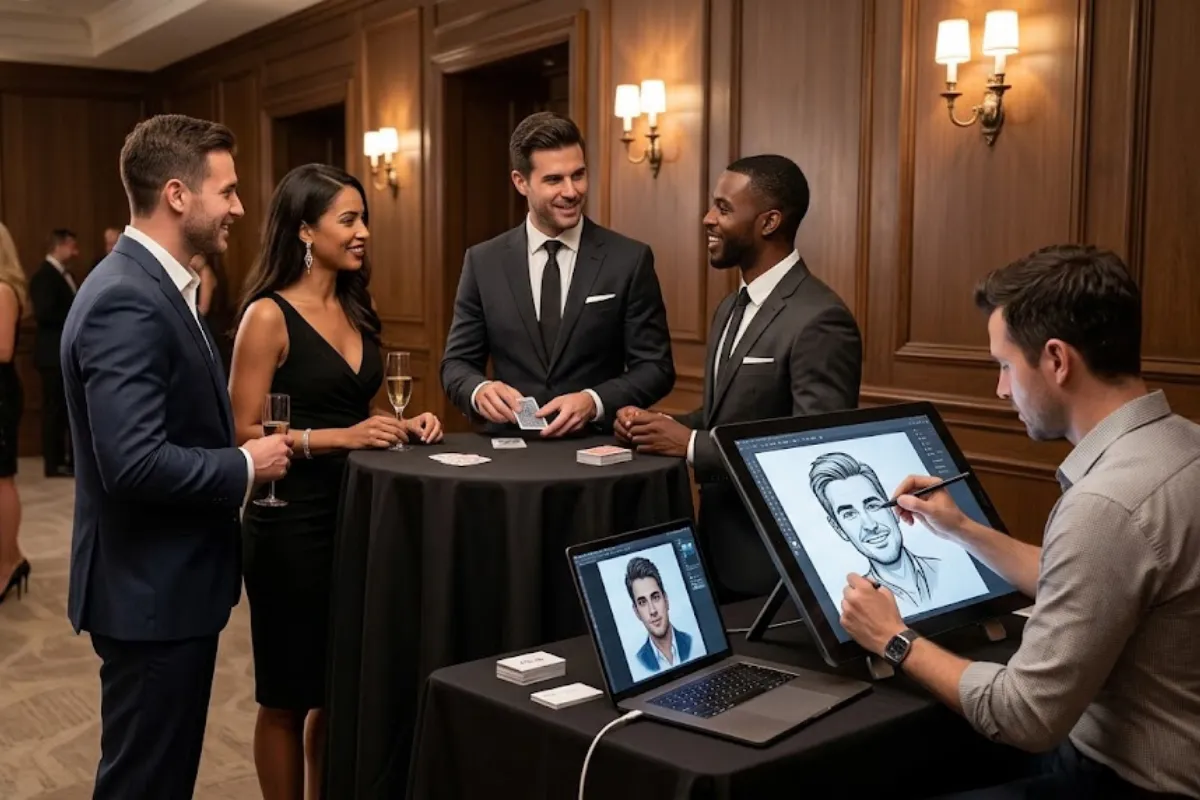
Matching corporate event entertainment to the room comes down to three variables: your guest mix, your event goal, and the physical space. A DJ who packs a dance floor at a 200-person holiday party will be the wrong choice for a 40-person executive dinner. A live band that energizes a gala may overwhelm a networking reception where the point is conversation. The right entertainment format makes your event feel intentional. The wrong one makes it feel off, even when nothing technically went wrong.
This guide walks through how to evaluate your audience, your room, and your event goal to pick the entertainment format that fits, with real comparison data from corporate events our production team has supported across Baltimore, Orlando, and nationwide.
Entertainment is not decoration. It shapes the entire guest experience. Start by naming the event’s primary goal, then match the format to it.
Goal: Celebration and morale. Holiday parties, end-of-year celebrations, milestone events. Guests want to eat, drink, and dance. A DJ with full dance floor lighting is the most reliable format. A live party band with a strong front person adds a visual focal point. Interactive options like a silent disco or casino tables work if your crowd skews younger or you want to give non-dancers something to do.
Goal: Client entertainment and relationship building. Client appreciation dinners, networking receptions, hospitality suites. The entertainment supports conversation. It does not compete with it. A jazz trio, solo pianist, or acoustic duo playing at background level is the standard playbook. A DJ playing a curated dinner playlist at low volume also works. The format that usually fails here is a loud band or a high-energy DJ set. Your guests are there to talk to each other.
Goal: Awards and recognition. Annual galas, sales kickoffs, awards dinners. The evening has a formal structure: dinner, speeches, awards, then dancing. Entertainment needs to handle the MC and transition role between program segments. A DJ who is also a skilled emcee is the most practical choice. A band can work if they are comfortable playing short sets between awards and can adjust volume for speech segments.
Goal: Team building and participation. Company retreats, off-sites, morale events where participation is the point. Interactive formats work here: dueling pianos where the audience picks the songs, karaoke with a live band backing track, casino tables with professional dealers, or a silent disco with three channels of competing playlists. These formats work because they give guests something to do together rather than something to watch.
| Factor | DJ | Live Band (4 to 8 pieces) | Interactive Experience
|
|---|---|---|---|
| Room size suitability | Any size. Scales with PA system. | Best in rooms over 150 guests. Needs stage space. | Depends on format. Casino needs table space. Silent disco needs open floor area. |
| Volume control | Precise. Adjustable in real time. | Limited. Acoustic drums set a noise floor that is hard to play under. | Silent disco: each guest controls their own. Casino/karaoke: localized zones. |
| Music variety | Unlimited. Any genre, any era, on request. | Limited to the band’s setlist. Most corporate bands cover 40 to 80 songs across genres. | Depends on format. Karaoke is unlimited. Dueling pianos covers a broad range. |
| Visual impact | Moderate. Lighting and setup can be styled. | High. A band on stage is a visual focal point. | High. Guests are part of the visual. The room feels active. |
| Guest participation | Dancing. Requests. MC interaction. | Dancing. Crowd interaction from the stage. | High. Guests are doing the activity, not just watching it. |
| Stage and power requirements | Low to moderate. 2 to 4 dedicated 20-amp circuits. | High. Large stage, backline power, monitor mix, dedicated sound engineer. | Varies. Silent disco needs charging stations. Casino needs dealer areas with lighting. |
| Typical cost range (talent only) | $1,200 to $5,000 | $5,000 to $15,000 | $2,500 to $10,000 |
| Best event types | Holiday parties, galas, awards dinners, networking events | Galas, celebrations, large-format parties | Team building, retreats, after-parties, events with mixed guest types |
These cost ranges reflect talent fees in Mid-Atlantic and Southeast markets. They do not include the production infrastructure (sound, lighting, staging) that the format requires. Always budget production separately from talent.
The room dictates what is possible before the guest list or the budget does. Walk the venue early and evaluate these physical factors:
Ceiling height. A room with ceilings under 10 feet creates challenges for live sound. Drums and amplified instruments bounce off a low ceiling and create a muddy mix at any volume. A DJ playing through a properly tuned PA handles low ceilings better than a band does. If the room has high ceilings (16 feet or more), a band can breathe and a lighting rig can create scale and drama.
Room shape. A long, narrow room creates audio dead zones at the far end. An L-shaped room means half your guests cannot see the stage. Both problems are solvable with additional PA fills and video relay screens, but those add to your production budget. A square or slightly rectangular ballroom is the easiest shape to produce in.
Stage location. If the venue has a fixed stage, you are building your room layout around it. If the stage is portable, you control where it goes. Place it where sight lines from every table are clear. A stage tucked behind a column or in an alcove sends a message that the entertainment was an afterthought.
Acoustics. Ballrooms with carpet, heavy drapes, and upholstered chairs absorb sound and create a warmer, quieter room. Rooms with hard floors, glass walls, and high ceilings are acoustically live and can get harsh at volume. Your AV provider can compensate with speaker placement and EQ, but they need to know the room’s acoustic character before they design the sound system.
Corporate events have wider age ranges, more varied music tastes, and more complex social dynamics than weddings. A 25-year-old analyst and a 58-year-old executive attend the same event. Your entertainment needs to work for both of them.
A DJ handles this best because the setlist can shift in real time. Start with recognizable dinner music at moderate volume. Move into a broad mix of danceable hits once the floor opens. A skilled corporate DJ reads the room and adjusts. If the dance floor is mostly younger employees, lean into current tracks. If it is a mixed group, layer in the Motown, 80s, and 90s tracks that span generations.
A live band should be booked for their specific sound and audience. A cover band that plays Top 40 hits will have broader appeal than a jazz ensemble or a tribute act. Ask for video of a live performance, not a studio recording. You want to see how they engage a room, not how they sound in a controlled environment.
Interactive experiences work particularly well for mixed crowds because they give people options. Silent disco channels let each guest pick their genre. Casino tables give non-dancers an activity. Dueling pianos create a shared singalong experience that crosses age groups. The key is offering multiple ways to participate so no one feels stuck at a table.
The questions that matter are about logistics and backup plans, not just the playlist. Ask these before you sign:
The entertainment needs to know the event flow, not just the start and end times. Give them a run of show that includes every transition point:
Walk through this with your entertainment vendor and your AV provider during the pre-production meeting. Everyone should know whose microphone is hot at every moment and when the energy level is supposed to shift.
A DJ with dance floor lighting is the most reliable format for a corporate holiday party. It scales to any room, handles speeches and announcements, and plays the broadest range of music. A live party band adds energy and a visual centerpiece but costs more and needs more production infrastructure. Both work. The decision between them usually comes down to budget and the formality level of the event.
During dinner and speeches, aim for 65 to 75 decibels at the guest tables. That is loud enough to hear the music clearly but quiet enough for conversation without raised voices. During dancing, 90 to 100 decibels at the dance floor is typical, with the level dropping as you move toward the back of the room. If guests at the back tables have to shout to be heard, the volume is too high. A professional AV provider meters the room during the event and adjusts in real time.
Yes, and this is a strong format for larger galas and celebrations. The band plays during dinner and the first dance set. The DJ covers band breaks, handles late-night dance energy, and takes over after the band finishes. The production infrastructure needs to support both, which means a sound system with enough inputs for the band’s full channel list plus the DJ’s rig, and a stage large enough that the DJ setup does not block the band. Budget for the additional coordination and equipment.
Background-level music that supports conversation without overpowering it. A jazz trio, acoustic duo, solo pianist, or a DJ playing a curated low-volume playlist all work. The volume should sit around 60 to 70 decibels at the main networking area. Avoid formats that demand attention (bands, high-energy DJ sets, interactive shows) unless you have a separate room for the entertainment and the networking happens elsewhere.
Book 8 to 12 weeks out for prime December dates and 4 to 8 weeks out for off-peak dates. The best corporate DJs and bands in Baltimore, Orlando, and other major markets fill their December calendars by late September or early October. Spring conference season (March through May) sees similar pressure. If you are planning a last-minute event, call multiple providers rather than settling for the first one with availability.
A stage or riser lifts the DJ above the crowd and makes the setup look professional rather than a folding table in a corner. For events over 80 guests, an 8-by-8 or 12-by-8 portable stage is worth the cost. It also keeps cables and equipment off the floor where guests walk and gives the DJ a better view of the room for reading the crowd.
Multi-room events need separate audio zones with independent volume control. The general session or main room gets the highest production value. Breakout rooms, lounges, and dining areas get background-level music from smaller PA systems or powered speakers. A single DJ can feed music to multiple rooms with a zone controller, or you can run separate playlist setups in each space. Your AV provider should design the audio distribution so no room bleeds into another.
The right entertainment makes your event memorable for the right reasons. If you are planning a corporate event and want help matching the entertainment to your room, your crowd, and your goals, contact Event Solutions Group. We provide production, AV, and entertainment services for corporate events across Baltimore, Orlando, and nationwide, and our team can help you book and produce the format that fits your event.
"*" indicates required fields