
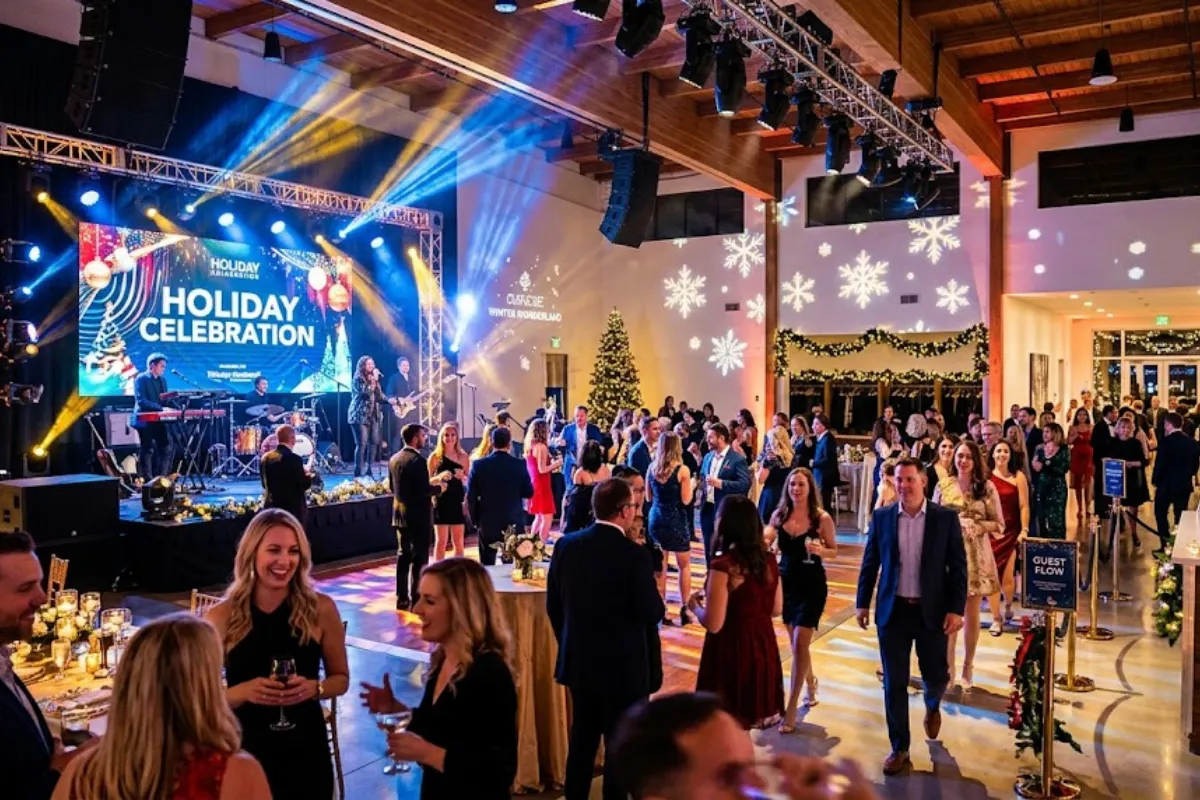
A corporate holiday party production checklist keeps your team on schedule, prevents last-minute AV failures, and makes sure every dollar you spend on lighting and entertainment shows up on the night. After producing holiday events across Baltimore and Orlando for companies ranging from 50-person office parties to 1,200-guest corporate galas, our production team built this checklist to walk you through the timeline, the tech, and the decisions that matter most.
This guide works for planners at any stage: starting from scratch in September, finalizing details in November, or scrambling to fix a gap two weeks out.
The single most common mistake we see is a company booking the venue and catering first, then calling an AV provider in November only to discover the room needs $8,000 in extra gear to work properly. Start production conversations the same week you sign the venue contract.
Here is the timeline our production team uses for December events:
| Timeline | Task | Who Owns It | Notes
|
|---|---|---|---|
| 8-12 weeks out | Book venue, confirm date, set production budget | Event planner / EA | Ask venue for floor plan, power map, load-in rules, and noise restrictions now. Get these in writing. |
| 8 weeks out | Hire AV / production partner, walk the venue together | Event planner + AV provider | Bring your AV partner to the venue during operating hours. Test the house sound system. Identify power drop locations. |
| 6 weeks out | Finalize entertainment format and book talent | Event planner | DJ, band, or interactive experience. Talent availability tightens fast for December Saturdays. Book with a signed contract and deposit. |
| 4 weeks out | Design lighting plan, confirm special effects | AV / lighting provider | Uplighting, stage wash, monogram/gobo projection, dance floor lighting. Confirm color palette and any branding requirements. |
| 3 weeks out | Finalize guest flow layout, seating chart, stage position | Event planner + AV provider | Where does the stage go? Where are the bars? How do guests enter? Map the path from coat check to bar to dance floor. |
| 2 weeks out | Create full run of show with cues and timing | Event planner + AV provider | Every speaker, award, dinner course, and music change gets a time stamp and an AV cue. |
| 1 week out | Confirm all vendor load-in times, power needs, insurance | Event planner | Send a single production schedule to every vendor. Confirm COIs are on file with the venue. |
| Day before | Load-in: staging, truss, lighting, sound check | AV / production provider | Venues with morning events the same day may restrict load-in to afternoon or evening. Confirm access windows. |
| Day of event | Final sound check, lighting test, walk-through with venue manager | Entire production team | Run the full show flow once on-site. Test every microphone. Confirm backup equipment is staged and ready. |
Production decisions flow from the event’s purpose, not from a gear catalog. Before you book a single piece of equipment, answer three questions:
First, what is the primary goal? Is this a morale event after a tough year? A client appreciation evening? A formal awards gala? Each drives different production choices. A morale party might want a high-energy DJ and an open dance floor. A client appreciation event often needs seated dinner, a band that plays at conversation volume during cocktails, and clean branding throughout the room.
Second, who is attending? The guest list determines room layout, entertainment style, and volume levels. A mixed group of employees and spouses needs something different from an all-staff party. Know your headcount before you book a venue.
Third, what is the real budget? Not just the catering number. Production, AV, lighting, and entertainment should be 25 percent to 35 percent of the total event budget for a party where music and atmosphere matter. If your catering is $15,000 and your AV budget is $800, the math does not work. Adjust one or the other.
A venue sales tour shows you how pretty the ballroom looks. A technical walk-through tells you whether your event will actually work there. Bring your AV provider to this one.
Check these items during the walk-through:
AV for a holiday party is different from AV for a conference. You are not presenting slide decks. You are filling a room with music, lighting a stage, and possibly running a short awards or speech segment.
At minimum, plan for:
Optional but high-impact additions include a video wall or projector for a year-in-review reel, a photo booth with branded print templates, and uplighting around the room perimeter to set the mood.
Lighting is the fastest way to make a hotel ballroom or raw event space feel like a thought-out event instead of a conference room with tables. Our production designers start with three layers:
Room wash / uplighting. LED uplights placed around the room perimeter wash the walls in your brand or holiday colors. This alone changes the feel of the space. Twenty to thirty uplights cover a typical 200-guest ballroom. Programmable LED units let you shift colors throughout the night: warm amber during dinner, deep blue and magenta when the dance floor opens.
Stage and focal-point lighting. The stage, the band or DJ area, and any branding elements (step-and-repeat, company logo) need dedicated light. Pin spots on centerpieces and table decor add depth without adding cost.
Dance floor lighting. Moving heads, wash lights, and effects like snow or haze (venue-permitting) turn a cleared area of carpet into a dance floor people actually use. The difference between a room with uplighting and a room with uplighting plus moving dance floor lights is the difference between “nice dinner” and “party.”
Your lighting provider should give you a plot showing fixture placement, color programming, and which circuits each fixture draws. If they cannot produce a plot, they are not a production company.
The entertainment format determines your entire AV setup, your stage size, your power requirements, and your room layout. Choose early and build the production around it.
A DJ works for almost any room size and gives you the most flexibility on music selection and volume. A live band brings energy and a visual focal point but needs a larger stage, more power, a dedicated monitor mix, and a sound engineer who knows the room. An interactive experience (dueling pianos, silent disco, karaoke, casino tables) changes the room layout entirely and may need separate audio zones.
Ask these questions before booking:
We cover this decision in more detail in our guide to matching corporate event entertainment to the room.
Guest flow is the sequence of spaces and experiences a guest moves through: arrival, coat check, bar, dinner, speeches, dance floor, dessert, exit. When the flow works, guests never feel lost or stuck. When it does not, you get a bottleneck at the one bar and a dance floor no one finds.
Map the room in zones:
Walk the flow yourself before guests arrive. Start at the entrance and walk every path a guest would take. Fix the bottlenecks before the doors open.
A run of show is a timed, line-by-line schedule that every vendor works from. It lists every moment of the event and the production cue that supports it. Without one, your CEO walks on stage to a dead microphone while the DJ takes a break.
At minimum, your run of show should include:
Distribute the run of show to every vendor at least one week before the event. Walk through it at the pre-production meeting. Changes will happen. A shared document that everyone can see means changes get communicated to everyone at once.
Start venue and date selection in August or early September for a December event. Prime Saturday dates in Baltimore and Orlando book 6 to 12 months ahead for larger venues. Production and entertainment should be locked by mid-October at the latest. The companies that call us in November with a date and a venue get a narrower set of options on talent and equipment, but we can still produce a strong event with 4 to 6 weeks of lead time.
For a party of 100 to 200 guests, production, AV, lighting, and entertainment combined typically range from $5,000 to $25,000 depending on the format. A DJ with basic sound and uplighting starts around $3,500 to $6,000. Add a live band, full stage lighting, and video and the number moves to $15,000 to $25,000. These are industry ranges based on mid-Atlantic and Southeast market rates. Your actual quote depends on your venue, headcount, and production requirements.
Sometimes. House systems work for background music and speeches in smaller rooms. They are rarely adequate for a band, a DJ pushing dance-floor volume, or a room larger than 150 guests. Have your AV provider evaluate the house system during the technical walk-through. If you need to supplement it, that is usually cheaper than bringing in a full external system from scratch.
A stage or riser lifts the DJ above the crowd and makes the setup look intentional rather than a table in the corner. For a casual office party in a small room, you can skip it. For anything with 80 guests or more, a small portable stage (8-by-8 or 12-by-8 feet) improves visibility and keeps cables and equipment off the floor where guests walk.
Start with room uplighting in your brand or holiday colors. Add stage wash for the DJ, band, or speaker area. If you have a dance floor, add moving head lights or dance-floor-specific effects. The uplighting alone typically runs $25 to $45 per fixture depending on whether they are standard or wireless, with most ballrooms needing 20 to 30 units to create full room coverage.
Outdoor and tented events in Florida or a mild December in Baltimore need weather-protected equipment, generator power instead of wall circuits, and a tent structure rated for the weight of lighting fixtures. Production costs run 20 percent to 40 percent higher than an indoor equivalent because of the generator, weather contingency equipment, and additional labor for setup. Book your generator early. December is not peak outdoor event season, but holiday markets and light displays compete for the same rental inventory.
Waiting until November to book AV and entertainment. By then, the best talent is committed, the production companies with strong reputations are fully booked for prime December dates, and the venue may have already promised your date to another group with a signed production contract. The second most common mistake is treating lighting as optional. A room with uplighting looks like an event. A room without it looks like a meeting.
If you are planning a corporate holiday party in Baltimore, Orlando, or anywhere nationwide, contact Event Solutions Group to walk through your production needs and get a quote. Our team handles the full production picture: sound, lighting, staging, entertainment, and day-of coordination so you focus on your guests.
"*" indicates required fields